Introduction
Surgical procedures require high precision, safety, and hygiene. The surgical blade is a tool that plays a silent yet extremely important role, whether it is a small incision or an elaborate operation. This tiny instrument is of enormous importance to a surgeon. A sharp, sterile, and well-manufactured blade provides a clean cut along the tissue with the least possible damage so that the patient can recover fast.
This article discusses all about surgical blades, their types, materials used, applications, and the GST Corporation and why it is a name trusted for manufacturing and exporting premium-quality surgical blades in India.
Medical Blades and Their Applications in the Medical Field
Surgical blades are used throughout various medical fields; the following are some of the applications:
1. Surgery
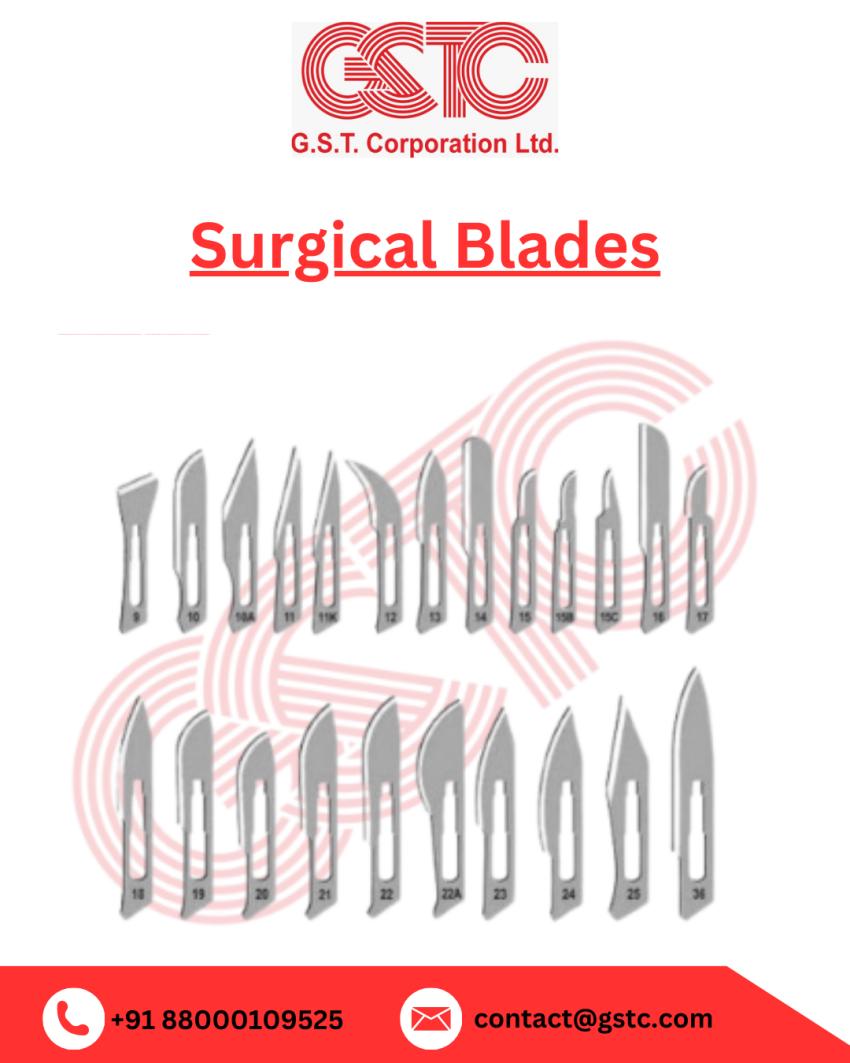
In surgery, blades such as 10 or 15 are used for incising skin, muscles, or organs.
2. Orthopedic Surgery
The precision blades are used to cut dense tissues and bones.
3. Cardiovascular Surgery
Operation around arteries and veins demands very fine, sharp blades.
4. ENT and Ocular Procedures
Blades 11 and 12 are preferred for small incisions and precise cuts.
5. Dermatology, Cosmetic Surgery
Used in grafting skin, mole elimination, and fine incision of the face.
6. Veterinary Surgery
Animals also undergo surgery, and the working of these blades constitutes an important medical entity in veterinary practice.
Advantages of Surgical Blades
High-quality surgical blades have several benefits that they offer for use in surgical procedures. An overview of the most important ones is as follows:
1. Highly Precise
These surgical blades are designed to be very fine in control and accuracy. Examples of delicate surgeries are those using cardiovascular, neurological, and plastic surgery. For these critical conditions, surgical blades are made to ensure sharp edges so that surgeons can make clean and controlled incisions.
2. Reduced Tissue Trauma
A cutting-edge sharpness cuts into skin and tissue without resulting in an injury to the surrounding tissue. All these result in resolves like:
- Less blood loss-
- Minimizes pain after the operation
- Minimum recovery period for patients
3. Safety Improvement
Individual packing and sterilization of each blade further reduce the risks of infection and cross-contamination in an operating room.
4. Versatility
They are adaptable from minor outpatient procedures to complex operations. A range of shapes and sizes of blades make them appropriate for use across multiple surgical disciplines.
5. Time Conservation
A razor-sharp blade takes less time and effort to cut through. It improves the surgery’s overall efficiency along with the time a patient spends under anesthesia.
6. Cheap and Disposable
Most of such surgical blades are single-use and very economical, thereby eliminating the cost and risk of re-sterilization and reuse.
Usages of Surgical Blades
1. General Surgery
- Main Use: To make incisions in skin and tissue during routine procedures.
- Blades Used: 10, 20, and 22.
- Examples: Appendicectomy, hernia repair, and cholecystectomy.
Importance: The sharpness of the blades guarantees accurate cuts with minimal tissue damage, thereby enhancing healing.
2. Cardiovascular & Thoracic Surgery
- Main Use: To make incisions with great care at sites of adjacent arteries, veins, and the heart.
- Blades Used: 11-sharp pointed; 15-small curved.
- Examples: Heart bypass surgery, valve replacement, lung resection.
Importance: Great precision is required here, where even minimal trauma can lead to severe consequences.
3. Plastic & Cosmetic Surgery
- Main Use: To carry out aesthetic-oriented procedures with the least possible scarring.
- Blades Used: 15- fine tip, 12- curved.
- Examples: Rhinoplasties (nose jobs), facelifts, scar revision.
Importance: Crisp incisions lead to better healing with a favorable cosmetic appearance.
4. Dermatology & Minor Skin Procedures
- Main Use: To create surface cuts, excise skin lesions, and biopsy the skin.
- Blades Used: 15, 11.
- Examples: Removal of a mole, excising a wart, skin cancer biopsy.
Importance: Requires shallow, controlled cuts to reduce noticeable scarring.
5. Dental Surgery
- Gum incisions, flap surgery, root surgery.
- Blades Used: 11, 12, and 15.
- Examples: Periodontal procedures and extraction.
Importance: When cuts are made with precision and efficiency in limited spaces, they produce less trauma and bleeding in the gums.
Conclusion
Whether performing minor outpatient procedures or surgeries that save lives, surgical blades are significantly important to individual surgical precision, safety, and successful clinical outcomes. As such, whether a healthcare provider, surgeon, hospital administrator, or medical equipment distributor, the importance of good-quality surgical blades cannot be overstated.
GST Corporation provides its full range of scalpels and blades in different sizes, sterilized packaging, and OEM/private label options to achieve surgical precision and B2B scalability. GST surgeon blades are globally trusted for their reliability, whether in executing delicate cosmetic procedures or facilitating bulk procurement to a hospital chain.